- Part 1New Mom's First 40 Days: A Gentle Day-by-Day Guide
- Part 2Baby Milestones from 0 to 3 Months: What to Expect
- Part 3When Do Babies Start Sitting? The Age and Signs to Know
- Part 4When Do Babies Start Eating? A Guide to Starting Solids at 6 Months
- Part 5When Do Babies Start Crawling? A Guide to Movement and Encouraging Your Baby
- 6Part 6Standing and First Steps: Your Baby's Journey to WalkingYou are here
- 7Part 7Speech and Language Development: From Babbling to the First Word
- 8Part 8From One to Two Years: Your Child's Growth Toward Independence
The first step is an unforgettable moment 🥹 But before it comes a whole journey: standing, cruising, then balance. In this article we walk you through it step by step (literally!) so you understand the stages and encourage your baby safely without rushing.
This is the sixth article in the Mom's Journey: From Birth to Two Years series. In the previous article we talked about crawling and movement — and now your baby moves from the floor onto their feet.
When do babies usually stand and walk?
- Pulling up on furniture: around 9–12 months.
- Cruising (holding furniture): 10–13 months.
- First independent steps: usually between 11 and 15 months, and can normally extend up to 18 months.
Walking up to 18 months is considered within normal. Don't compare your baby to others — every baby has their timing.
The stages on the way to walking
- Pulls up to stand holding the sofa or table.
- Cruises sideways holding furniture.
- Stands for seconds without holding then sits.
- Takes a step or two toward your arms.
- Walks confidently with lots of falls — a natural part of learning.
How to encourage walking safely
- Let them go barefoot indoors — it strengthens the foot muscles and improves balance and floor sense.
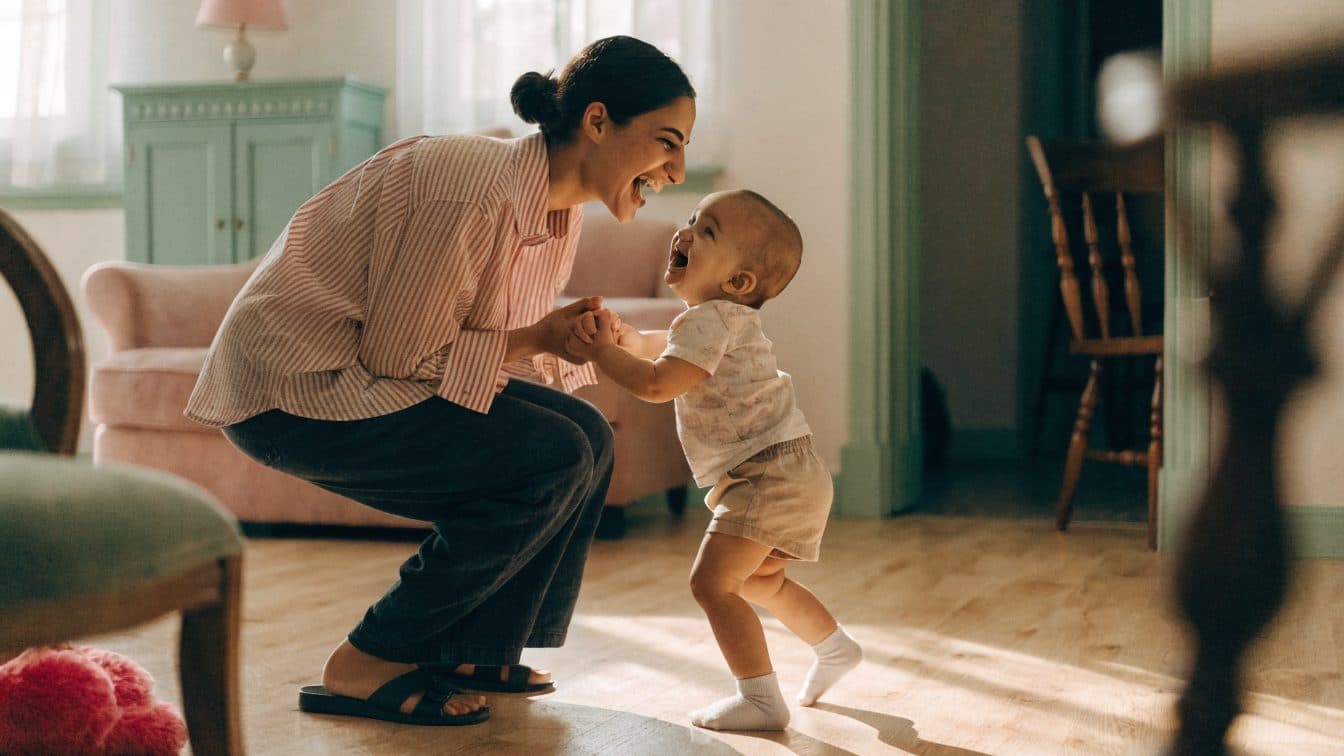
- Hold their hands and let them step toward you, or sit at a distance and open your arms.
- Provide stable furniture at a suitable height to cruise around (no sharp edges).
- Push toys (that they stand behind and push) are excellent for encouraging balance and steps.
- Celebrate every attempt — enthusiasm gives them confidence.
The truth about walkers ⚠️
The sit-in walker is not medically recommended: it may delay muscle development, cause an unhealthy foot position, and most dangerously it's a common cause of fall injuries (especially near stairs). The safe and useful alternative:
- Push toys the baby stands behind (push walkers) — support natural walking.
- Free play time on a safe floor.
Your baby's first shoe
When they start walking outdoors, choose a shoe that is:
- Flexible and light, bending easily (not stiff).
- The right size with a finger's space in front of the toes.
- Non-slip soled.
Indoors, bare feet remain best.
An approximate walking timeline
| Age | Skill |
|---|---|
| 9–10 months | Pulls up to stand with furniture |
| 11–13 months | Cruises sideways, stands alone briefly |
| 14–18 months | Independent steps then confident walking |
Remember: walking up to 18 months is normal. What matters most is that your baby progresses in strength and balance gradually.
When to see the doctor
- Not bearing any weight on the legs at 12 months.
- Not pulling up with furniture after 12 months.
- Not walking at all after 18 months.
- Always walking on tiptoes only, never placing the whole foot.
- Loss of motor skills previously gained.
Products that help with standing and walking 🛍️
All from stores that ship to Saudi Arabia and the Gulf:
- Classic World rainbow push toy — a push toy that encourages first steps and balance (not a sit-in walker).
- Winfun adventure walker train — a push wagon the baby stands behind and pushes while walking.
- Playgro 2-in-1 activity table & walker — an activity table that converts into a push-along walker.
- Fat Brain Spin Again — seated play strengthens the core that supports standing.
💛 Use code Life9 at Mumzworld — all my codes are on the discount codes page.
FAQ
My baby walks on tiptoes — is that normal?
At the start of walking it's common for a baby to occasionally try tiptoeing. But if it's always and they never place their heel, or it continues months after mastering walking, mention it to your doctor.
Should I put shoes on so they walk faster?
No, shoes don't teach walking. Bare feet indoors are better for muscle development and balance. Shoes are only for protection outdoors.
My baby is 16 months and not walking — should I worry?
Walking up to 18 months is within normal. If they pull up and cruise holding furniture, they're on track. If they aren't walking after 18 months, see the doctor.
How often do babies fall while learning?
Very often! Light falls are a natural part of learning balance. Secure the area (edges, floor), supervise, and let them try.
---
⚕️ Note: This content is educational only and is not a substitute for medical advice. Every child is different — if you have any concern about your baby's standing or walking, see your pediatrician.
Next in the series: Speech and language development: from babbling to the first word (coming soon 💚)