- Part 1New Mom's First 40 Days: A Gentle Day-by-Day Guide
- Part 2Baby Milestones from 0 to 3 Months: What to Expect
- Part 3When Do Babies Start Sitting? The Age and Signs to Know
- 4Part 4When Do Babies Start Eating? A Guide to Starting Solids at 6 MonthsYou are here
- 5Part 5When Do Babies Start Crawling? A Guide to Movement and Encouraging Your Baby
- 6Part 6Standing and First Steps: Your Baby's Journey to Walking
- 7Part 7Speech and Language Development: From Babbling to the First Word
- 8Part 8From One to Two Years: Your Child's Growth Toward Independence
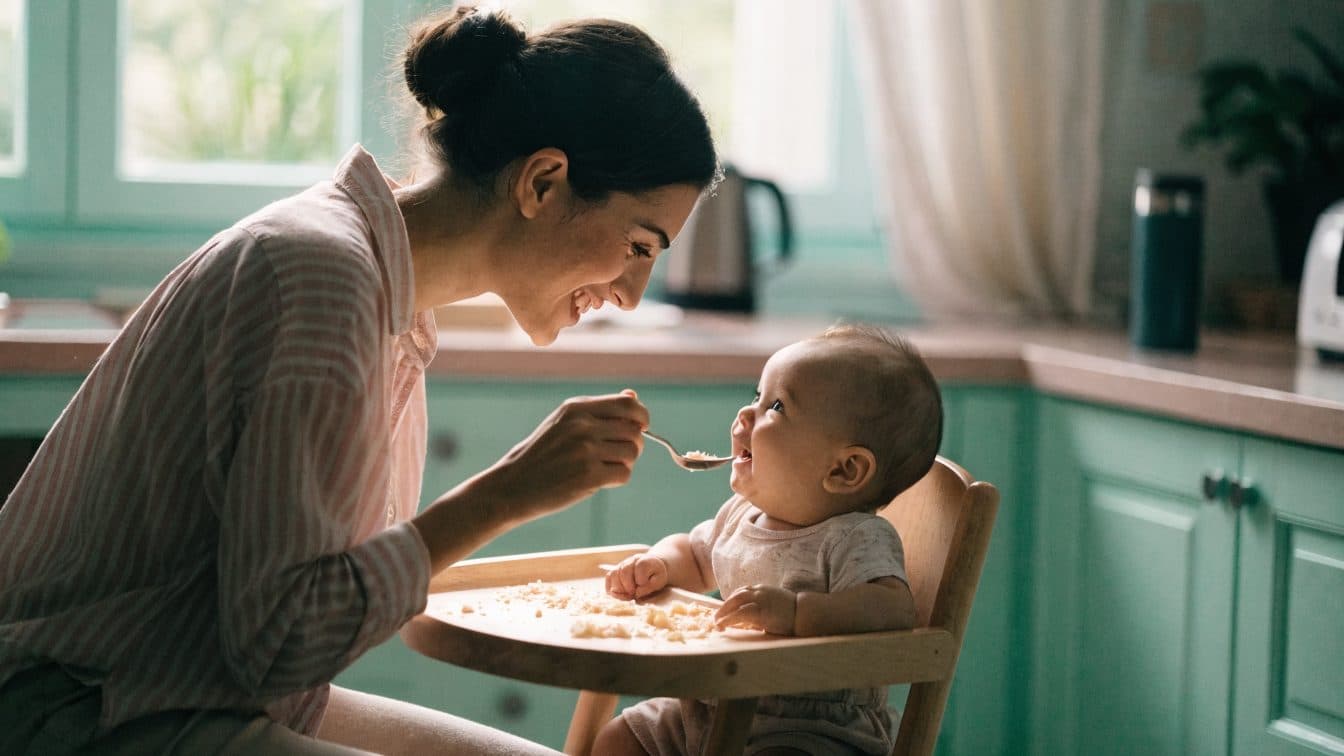
Starting solids is exciting and confusing at the same time — "When do I start? With what food? And how much?" Take a breath, I'll simplify it step by step 💛 The most important rule: don't start by age alone, but by readiness signs.
This is the fourth article in the Mom's Journey: From Birth to Two Years series. In the previous article we talked about sitting — one of the key signs of readiness for food.
When do babies usually start eating?
Most health authorities recommend milk only (breast or formula) until about 6 months, then introducing food alongside milk. Milk remains the main nutrition in the first year.
Important: never introduce any food before 4 months — the baby's digestive system and swallowing muscles aren't ready.
Signs your baby is ready for food
Start when these signs come together (usually around 6 months):
- Good head and neck control and sits steadily with support.
- Shows interest in food — watches you eat and reaches for it.
- Opens their mouth when the spoon approaches.
- Starts to swallow instead of pushing food out with the tongue (the "tongue-thrust reflex" fades).
The first suitable foods
There's no single "right" list, but gentle options to start:
- Boiled, mashed vegetables: sweet potato, carrot, zucchini, pumpkin.
- Mashed fruits: banana, avocado, cooked apple, pear.
- Iron-fortified cereals (like baby rice/oats).
- Well-mashed protein later: lentils, chicken, well-cooked egg.
Iron is very important at this stage, so introduce its sources early.
The right texture
- 6 months: very smooth purée (yogurt-like consistency).
- 7–8 months: coarser mash + soft finger pieces they can hold.
- 9–12 months: small soft pieces they eat themselves.
Let them explore and get messy — the mess is part of learning 😄
Allergies: introduce one food at a time
- Offer one new food every 2–3 days and watch for any reaction (rash, vomiting, diarrhea, facial swelling).
- For the most allergenic foods (egg, safely mashed peanut, dairy, wheat, fish), recent studies encourage early small-amount introduction rather than delaying — but consult your doctor, especially with a family history of allergy.
- Whole peanuts and nuts are a choking hazard — serve as thinned/smooth butter only, never whole.
Foods to avoid in the first year
- Honey — risk of infant botulism before age one.
- Added salt and sugar — a baby's kidneys and palate don't need them.
- Cow's milk as a main drink before one (small amounts in cooking are fine).
- Hard round foods (whole grapes, nuts, seeds) — choking hazard; cut lengthwise and small.
A simple starting-solids timeline
| Age | Food | Texture |
|---|---|---|
| 6 months | Mashed veg/fruit, iron cereal | Very smooth |
| 7–8 months | More variety + mashed protein | Coarse mash + soft pieces |
| 9–12 months | Most family foods (no salt/sugar/honey) | Small soft pieces |
Remember: the timeline is approximate, and every baby has their own rhythm. The main thing is trying varied flavours and textures gradually.
When to see the doctor
- Total food refusal that continues after several tries
- Signs of allergy (rash, swelling, breathing difficulty — the last is an emergency)
- Repeated choking or difficulty swallowing
- Not gaining weight appropriately
Products that may help at this stage 🛍️
Essentials that make starting solids easier — all from stores that ship to Saudi Arabia and the Gulf:
- Jikel Tron high chair — a stable chair with a safety harness for a safe mealtime (always buckle the harness and supervise).
- Eazy Kids drying rack — to dry plates, spoons, and cups cleanly.
- Luqu cleaning brush set — to clean feeding tools and bottles thoroughly.
- WaterWipes — to clean face and hands after every messy meal.
💛 Use code Life9 at Mumzworld and BCL5018 at iHerb for feeding supplies — all my codes are on the discount codes page.
FAQ
Should I start with vegetables or fruit?
There's no mandatory order. Some moms start with veg to avoid a sweet preference, but variety over time matters most. A baby may need to try a flavour several times before accepting it.
How much food at the start?
A spoon or two once a day is enough at first — the goal is learning, not filling up. Milk stays the main source. Increase gradually as your baby takes to it.
My baby refuses food entirely — what do I do?
Normal at first. Don't force it, try again later with a different flavour/texture, and offer food when they're hungry but not exhausted. Persistent refusal for several weeks warrants a doctor's visit.
Should I give water with food?
Yes, a small amount of water in a training cup with meals after 6 months is fine, without overdoing it so it doesn't reduce their milk feeds.
---
⚕️ Note: This content is educational only and is not a substitute for medical advice. Every child is different — if you have any concern about your baby's feeding or allergies, see your pediatrician.
Next in the series: Crawling and movement: how to help your baby explore the world safely (coming soon 💚)