- Part 1New Mom's First 40 Days: A Gentle Day-by-Day Guide
- Part 2Baby Milestones from 0 to 3 Months: What to Expect
- Part 3When Do Babies Start Sitting? The Age and Signs to Know
- Part 4When Do Babies Start Eating? A Guide to Starting Solids at 6 Months
- Part 5When Do Babies Start Crawling? A Guide to Movement and Encouraging Your Baby
- Part 6Standing and First Steps: Your Baby's Journey to Walking
- Part 7Speech and Language Development: From Babbling to the First Word
- 8Part 8From One to Two Years: Your Child's Growth Toward IndependenceYou are here
You've reached the final stop in our journey 🎉 Your baby is no longer an infant — they're a toddler with a personality and a will! One to two years is an explosion of movement, language, and independence… and tantrums too 😅 Here we gather everything you need for this delightful stage.
This is the eighth and final article in the Mom's Journey: From Birth to Two Years series. In the previous article we talked about speech development — and today we tie the whole journey together.
Growth leaps from one to two years
- Motor: walks confidently, starts running and climbing, goes up stairs with help, kicks a ball, builds a tower of blocks.
- Language: from single words to combining two words, then a language explosion around 24 months, follows two-step commands.
- Social & emotional: imitates adults, plays alongside other children, shows simple empathy, and begins pretend play (feeding a doll).
- Cognitive: sorts shapes and colours, solves simple puzzles, looks for hidden objects.
Independence and tantrums — normal!
Your toddler's favourite word "no" isn't stubbornness but self-discovery. Tantrums at this age are normal because their emotions are bigger than their ability to express them in words. How to handle them?
- Stay calm — your reaction fuels the tantrum.
- Name their feelings: "you're upset because we stopped playing."
- Give simple choices so they feel in control: "apple or banana?"
- A steady routine greatly reduces tantrums.
Eating and sleep at this stage
- Eating: eats most family foods, appetite fluctuates (normal), encourage variety without forcing. Offer healthy food and let them decide the amount.
- Sleep: about 11–14 hours a day including one nap (usually afternoon). Keep a comforting sleep routine.
Play ideas that grow their skills
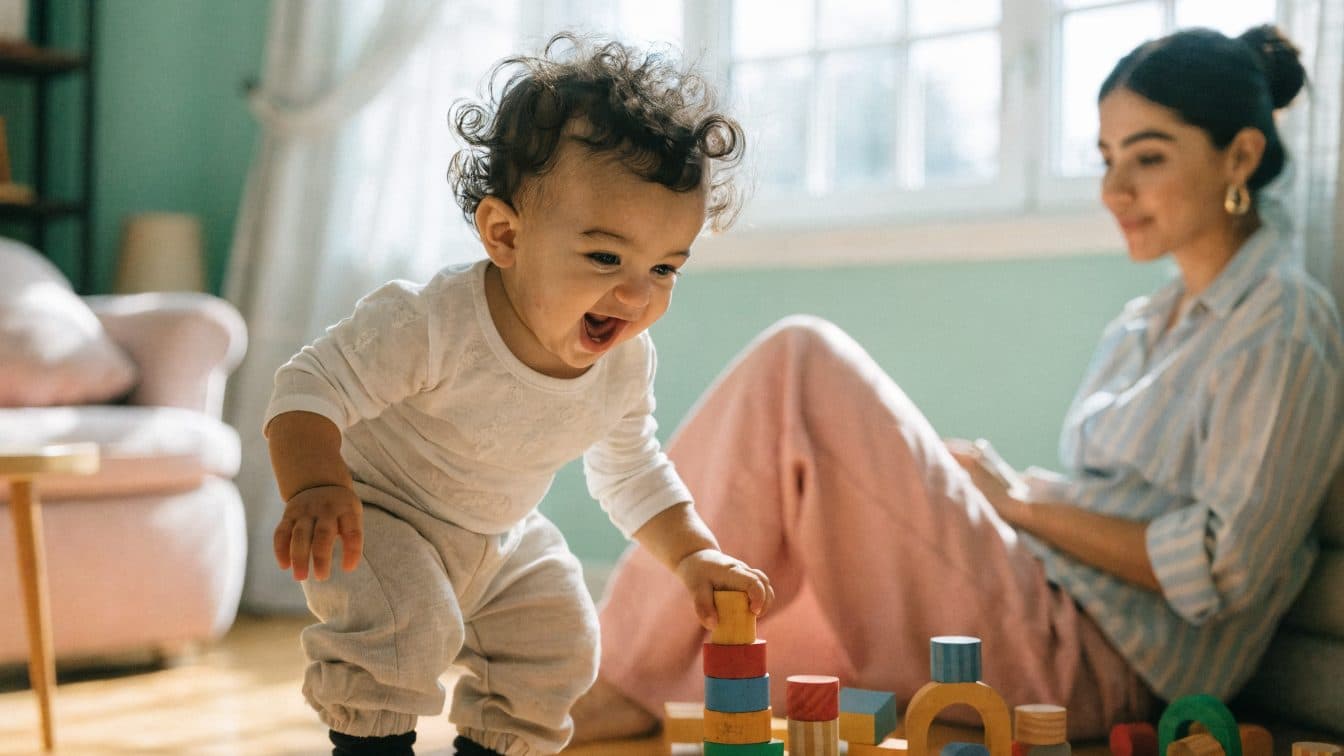
- Blocks and stacking — coordination and problem-solving.
- Shape and colour sorting — cognitive skills and vocabulary.
- Pretend play (kitchen, doll, cleaning) — language and social skills.
- Active play outdoors (ball, running, safe climbing) — energy and balance.
Approximate timeline: one to two years
| Age | Key skills |
|---|---|
| 12–15 months | First steps, 1–3 words, points to what they want |
| 15–18 months | Walks/runs a little, vocabulary expands, imitates |
| 18–24 months | Runs and climbs, combines two words, pretend play |
Remember: the timeline is approximate. Compare your child to themselves yesterday, not to other children.
When to see the doctor
- Not walking after 18 months.
- No meaningful words after 18 months, or not combining two words near 24 months.
- Loss of skills previously gained (motor, language, communication).
- Doesn't imitate, point, or make eye contact.
Products for this stage 🛍️
All from stores that ship to Saudi Arabia and the Gulf:
- Classic World stacking cubes — building and stacking that grow coordination and problem-solving.
- Fat Brain Spin Again — cause-and-effect and fun turn-taking.
- Delsit kids armchair — their own chair reinforces independence and comfy sitting.
- Lovely Baby storage rack with bins — teaches them to tidy their own toys.
💛 Use code Life9 at Mumzworld and BCL5018 at iHerb — all my codes are on the discount codes page.
FAQ
My toddler has many tantrums — is something wrong with my parenting?
Not at all. Tantrums are a normal developmental stage between one and three because emotions outgrow words. Calm, routine, and naming feelings ease them gradually.
My child eats very little — should I worry?
Fluctuating appetite is normal at this age as growth slows. Offer varied healthy choices and let them decide the amount without forcing. If they're active and gaining weight, they're usually fine — see the doctor if concerned.
When do I start potty training?
Most children are ready between 18 and 30 months when readiness signs appear (staying dry for stretches, telling you, interest in the toilet). Don't rush before readiness.
Should I compare my child to same-age children?
No. The normal range is very wide at this stage. Watch your child's progress over time, not their position versus others, and see the doctor at any genuine delay sign.
---
💛 Journey's end
From the first 40 days to two full years — we've walked with you step by step through your baby's growth. Always remember: there's no child who is "behind" by others' measures, only a child moving at their own pace. Your confidence, love, and presence are what they need most. You are a wonderful mom 🌸
⚕️ Note: This content is educational only and is not a substitute for medical advice. Every child is different — if you have any concern about your child's growth or development, see your pediatrician.
Explore the full series from the blog page 💚